---
title: Impacts of High Grid Voltage
description: Impacts of High Grid Voltage
---
[Skip to content](https://knowledge-base.solarhub.net.au/impacts-of-high-grid-voltage#main-content)

- [Customer Portal](https://441665238.hs-sites-ap1.com/tickets-view)
Open main navigation
Close main navigation
- [Customer Portal](https://441665238.hs-sites-ap1.com/tickets-view)
How can we help you?
- There are no suggestions because the search field is empty.
1. [SolarHub Knowledge Base](https://knowledge-base.solarhub.net.au/?hsLang=en-au)
2. [General](https://knowledge-base.solarhub.net.au/general?hsLang=en-au)
# Impacts of High Grid Voltage
### 
### Article Contents
**[Understanding High Grid Voltage](https://knowledge-base.solarhub.net.au/impacts-of-high-grid-voltage#understanding)**
**[Impact on Households](https://knowledge-base.solarhub.net.au/impacts-of-high-grid-voltage#impact)**
**[Why It's More Common Now](https://knowledge-base.solarhub.net.au/impacts-of-high-grid-voltage#why)**
[**Solutions**](https://knowledge-base.solarhub.net.au/impacts-of-high-grid-voltage#solutions)
### Understanding High Grid Voltage
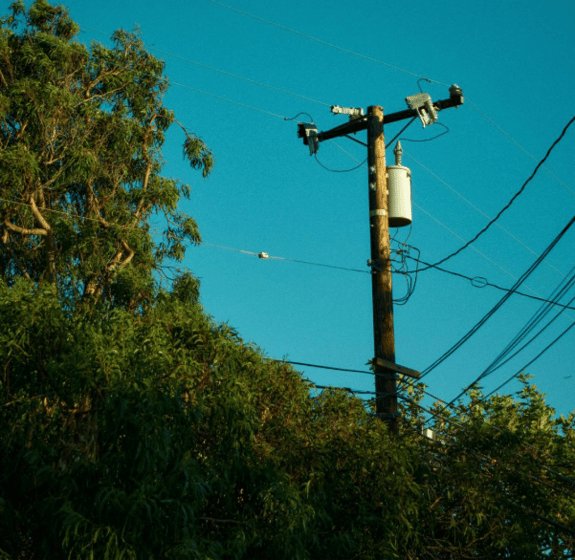
Grid voltage is central to the safe and reliable flow of electricity. To maintain system stability, it must stay within defined limits. In Australia, the standard grid voltage is 230V, with an allowable tolerance of +10% / –6%. This means the grid can operate between 216V and 253V without issue. While drops below 216V do occur, a far more common and problematic scenario is voltage rising above 253V. This is a condition known as high grid voltage.
### Impact on Households
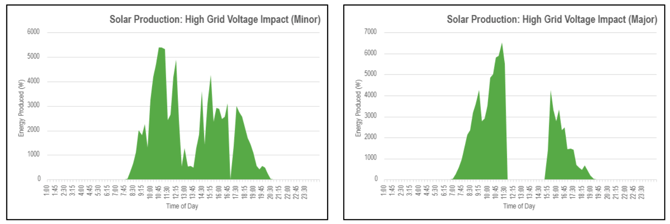
**Solar exports limited**: When voltage exceeds 253V, solar inverters automatically scale back their output to help stabilise the grid (left graph). If grid voltage goes higher, they may shut down completely, halting solar generation and exports for extended periods (right graph). This often occurs during peak sunlight hours, reducing both household energy savings and contributions to the grid.
### 
**Appliance stress and efficiency losses**: Household appliances are designed for 230V operation. If the grid voltage increases to an unstable amount, it can put significant stress on your appliances as they are now running on a voltage level that is higher than designed to manage. Prolonged exposure to higher voltages can cause them to consume more power, operate less efficiently, and, in severe cases, suffer premature wear or damage.
### Why It's More Common Now
The rapid growth of rooftop solar has fundamentally changed how Australia’s electricity grid operates. During peak solar generation (typically midday), household demand is often low, meaning most of the energy produced is exported directly into the grid. However, the grid was originally designed for one-way energy flow, from centralised power stations to homes and businesses. This mismatch creates stress on local networks, often pushing voltages above the safe operating range.
Although infrastructure upgrades are underway to better accommodate two-way energy flows, these are complex and costly projects. As a result, some areas of the grid are more prone to high voltage issues than others, particularly where solar adoption is high, but network capacity is limited.
### What to do if you see high-grid voltage on your energy monitoring
Beyond batteries, proactive system monitoring is essential. Keeping an eye on your inverter’s performance can help you spot voltage issues early, preventing unnecessary energy losses. While all new installations are inspected in the first few days, high voltage problems may develop months later as grid conditions change.
#### **If you notice signs of inverter shutdowns or reduced solar output, please contact SolarHub by raising a [Support Ticket](https://solarhub.net.au/raise-a-support-ticket/). We can investigate the issue and file a report with your utility provider to help resolve high voltage in your area.**
### Long-term energy ecosystem solutions
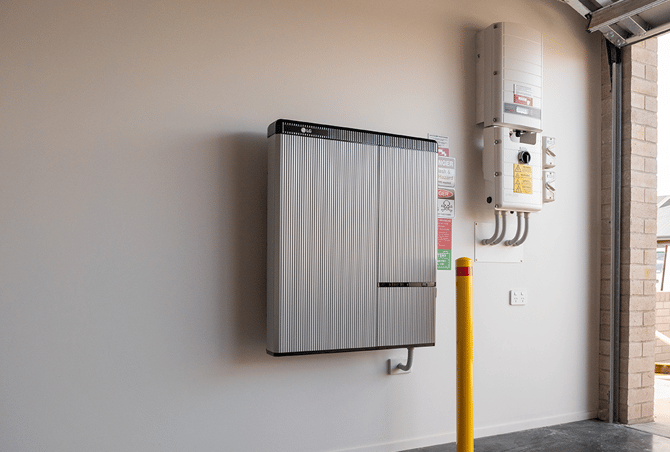
The most effective way to reduce the impact of high grid voltage is to consume more energy on site instead of exporting, either through load control or energy storage. Installing an energy management system, such as a battery, allows you to store excess solar generation for later use. This not only minimises exports during peak solar hours but also reduces reliance on the grid during the evening, when your solar isn’t producing.
To support this shift, the Australian Government has been rolling out battery rebate programs that make home storage more affordable. Adding a battery to an existing solar system is often cheaper and faster than large-scale grid upgrades, while also offering homeowners a reasonable payback period through increased energy savings. This creates a win–win scenario for both households and the wider network.
|  |  |
| --- | --- |
- [FAQs](https://knowledge-base.solarhub.net.au/faqs?hsLang=en-au#main-content)
- [General FAQs](https://knowledge-base.solarhub.net.au/faqs?hsLang=en-au#general-faqs)
- [Enphase](https://knowledge-base.solarhub.net.au/faqs?hsLang=en-au#enphase)
- [Fronius](https://knowledge-base.solarhub.net.au/faqs?hsLang=en-au#fronius)
- [Sigenergy](https://knowledge-base.solarhub.net.au/faqs?hsLang=en-au#sigenergy)
- [SolarEdge](https://knowledge-base.solarhub.net.au/faqs?hsLang=en-au#solaredge)
- [Tesla](https://knowledge-base.solarhub.net.au/faqs?hsLang=en-au#tesla)
- [Troubleshooting](https://knowledge-base.solarhub.net.au/troubleshooting?hsLang=en-au#main-content)
- [General Troubleshooting](https://knowledge-base.solarhub.net.au/troubleshooting?hsLang=en-au#general-troubleshooting)
- [Enphase](https://knowledge-base.solarhub.net.au/troubleshooting?hsLang=en-au#enphase)
- [Fronius](https://knowledge-base.solarhub.net.au/troubleshooting?hsLang=en-au#fronius)
- [Reposit](https://knowledge-base.solarhub.net.au/troubleshooting?hsLang=en-au#reposit)
- [Sigenergy](https://knowledge-base.solarhub.net.au/troubleshooting?hsLang=en-au#sigenergy)
- [SolarEdge](https://knowledge-base.solarhub.net.au/troubleshooting?hsLang=en-au#solaredge)
- [Tesla](https://knowledge-base.solarhub.net.au/troubleshooting?hsLang=en-au#tesla)
- [Sunpower](https://knowledge-base.solarhub.net.au/troubleshooting?hsLang=en-au#sunpower)
- [Sungrow](https://knowledge-base.solarhub.net.au/troubleshooting?hsLang=en-au#sungrow)
- [Solax](https://knowledge-base.solarhub.net.au/troubleshooting?hsLang=en-au#solax)
- [General](https://knowledge-base.solarhub.net.au/general?hsLang=en-au)
[](http://solarhub.net.au)
[mailto:email@email.com](mailto:email@email.com)
Copyright © 2025, SolarHub