---
title: Reverse Cycle Air Conditioning 101
description: Reverse Cycle Air Conditioning 101
---
[Skip to content](https://knowledge-base.solarhub.net.au/reverse-cycle-air-conditioning-101#main-content)

- [Customer Portal](https://441665238.hs-sites-ap1.com/tickets-view)
Open main navigation
Close main navigation
- [Customer Portal](https://441665238.hs-sites-ap1.com/tickets-view)
How can we help you?
- There are no suggestions because the search field is empty.
1. [SolarHub Knowledge Base](https://knowledge-base.solarhub.net.au/?hsLang=en-au)
2. [General](https://knowledge-base.solarhub.net.au/general?hsLang=en-au)
# Reverse Cycle Air Conditioning 101
### Article Contents
[Ducted vs. Split](https://knowledge-base.solarhub.net.au/reverse-cycle-air-conditioning-101#dvss)
[How Does It Compare to Gas?](https://knowledge-base.solarhub.net.au/reverse-cycle-air-conditioning-101#how)
[Outdoor Units and Freezing in Winter](https://knowledge-base.solarhub.net.au/reverse-cycle-air-conditioning-101#outdoor)
[Recommendations](https://knowledge-base.solarhub.net.au/reverse-cycle-air-conditioning-101#recomm)
### Ducted vs. Split
**Ducted**
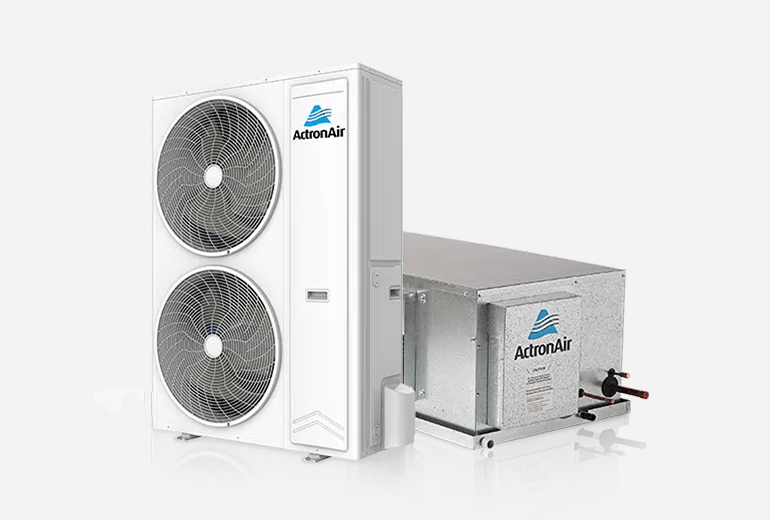
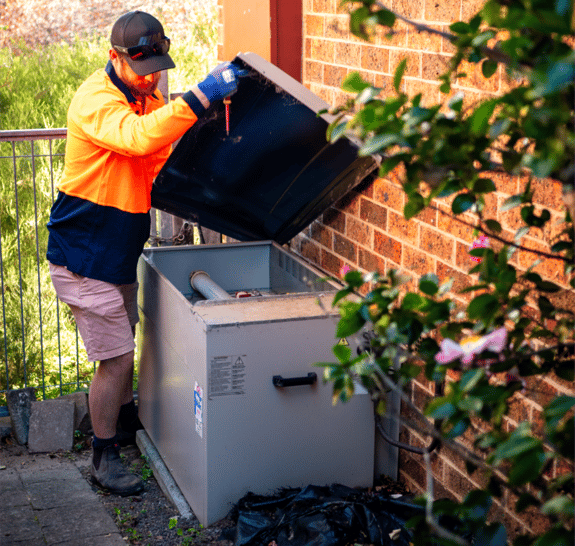
A ducted system works by having a central unit that distributes air into the household through ducts or outlets located in rooms, either in the ceiling or floor. In the roof space or floor, depending on the system, you’ll find the fan deck. This component is connected to the outdoor unit and the refrigerant, and its job is to push air out into the ducts.
The system operates with both an output and return venting system. The return vent takes the temperature from inside the house and channels it through the fan deck to be either heated or cooled. The treated air is then pushed back into the system and circulated into the household through the outlets.
Placement of the return ventilation system depends on three main factors: how much airflow it receives, the temperature of the air being drawn in, and aesthetic considerations. In most cases, the return vent should be close to the controller, since the controller measures the home temperature. This is often in a hallway where airflow is strong, and the vent is less intrusive.
**Splits**
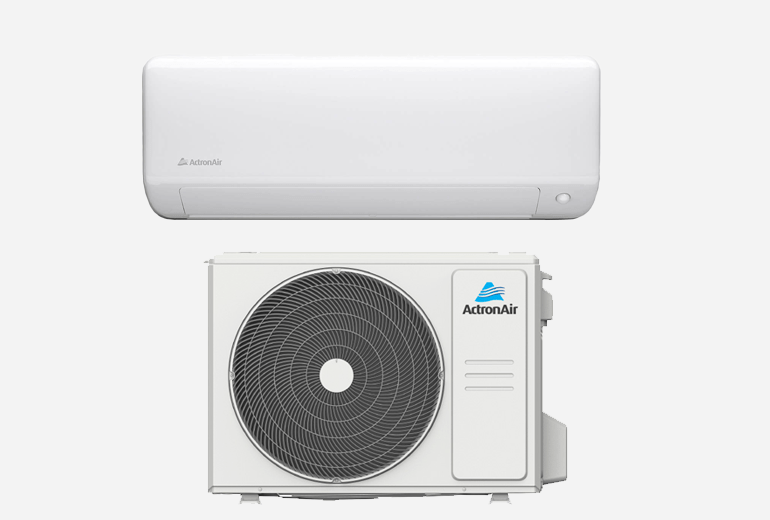
Split systems consist of a wall-mounted indoor unit paired with an outdoor unit, linked together by a refrigerant pipe. They are available in different capacities, suited to various spaces:
- 2kW and 3kW systems for bedrooms or study rooms
- 5kW systems for small lounges, living rooms, or large bedrooms
- 7kW systems for open or larger living areas
- 8kW systems for open connected spaces or homes with raised ceilings
Splits work best when installed on a per-room basis. Attempting to use one unit to cover multiple spaces leads to efficiency losses and uneven performance. Unlike ducted systems, the output and return functions of a split system are handled by a single indoor head unit, which performs both duties.
### How Does It Compare to Gas?
Compared to gas heating, reverse cycle systems produce air at a significantly lower temperature. Gas heaters can heat air up to 70-75 °C, while reverse cycle systems typically blow air at 40-45 °C. Although this lower outlet temperature may seem less efficient, reverse cycle units compensate with a much higher volume of air output. For example, gas heaters may circulate around 750 L/s of air, while reverse cycle systems can deliver over 1200 L/s of air depending on the size of the unit.
When it comes to heating speed, gas heaters have the advantage. From a starting temperature of 10 °C, gas heaters usually reach the desired temperature in 10-15 minutes, whereas reverse cycle systems can take up to an hour. However, gas heating tends to create less even air distribution, with hot spots near the outlet and cooler areas further away. By contrast, reverse cycle systems, though cooler at the outlet, distribute warm air more evenly across the space thanks to their higher airflow.
Another key difference is energy efficiency. Reverse cycle systems require considerably less energy to run compared to gas. Their performance is measured using the Coefficient of Performance (CoP), which indicates how many kilowatts of heat output are produced for each kilowatt of energy input. In ideal conditions, reverse cycle units achieve a CoP of 3.5-4, meaning they produce 3.5-4 kW of heating for every 1 kW consumed. In contrast, gas ducted and wall-mounted heaters typically achieve a CoP of only 0.9-1.
While gas heating provides hotter air and faster warm-up times, reverse cycle systems are up to 4 times more energy-efficient and deliver more consistent comfort throughout the home. For practical guidance on getting the most out of reverse cycle heating, see the recommendations section.
### Outdoor Units and Freezing in Winter
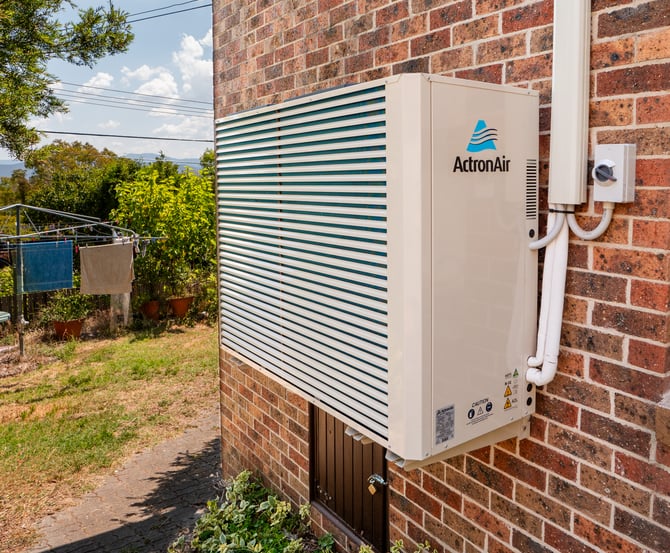
Every outdoor unit contains a compressor, which is essentially the heart of the system. The compressor is responsible for pumping pressurised refrigerant throughout the system, working in combination with a coil design. In winter, this coil operates at around 45-50 °C to provide heating, while in summer it runs cooler, typically between 4-10 °C, to enable cooling.
Split systems generally use a single-fan compressor, with the size of the compressor increasing as the system capacity grows. In comparison, large ducted systems are built with a double-stacked fan design, which can be oriented either vertically or horizontally depending on the brand.
During winter, outdoor temperatures can cause the coil to freeze, especially in the early morning. Over time, the ice naturally melts as outdoor conditions warm and as refrigerant continues to circulate through the coil. However, when freezing does occur, the system automatically redirects energy into heating the coil to remove ice buildup (a process known as defrost mode). It is important to never switch off the system while it is in defrost mode. Doing so can interrupt the cycle and create further issues with operation. This may delay the starting time of your air conditioning unit. In a defrost mode, the system will push cold air in the house as it diverts heat in the coil, but the defrost cycle doesn't last very long, so just let it defrost, and system will operate as usual just after.
### Recommendations
- **Turn ON before waking up:** By having your reverse cycle on a timer to heat up your home before you wake up, this gives the system the necessary time required to start up. It's recommended to turn on your system at least an hour before you wake up to ensure that airflow has reached throughout your home. You can easily do this by scheduling turn on and turn off times on your system control or through a mobile app.
- **Isolating non-important rooms:** Depending on your system, you may be able zone to different rooms. A benefit of this is the ability to ignore rooms that don't require immediate airflow. Whilst it may only show marginal economic benefit, it provides additional convenience to your home. Read more here about zoning your home:
- *Zoning your Air Conditioning System*
**If you have any additional enquiries or encounter issues with your system, contact us by raising a [Support Ticket](https://solarhub.net.au/raise-a-support-ticket/) and we can investigate the issues further. **
- [FAQs](https://knowledge-base.solarhub.net.au/faqs?hsLang=en-au#main-content)
- [General FAQs](https://knowledge-base.solarhub.net.au/faqs?hsLang=en-au#general-faqs)
- [Enphase](https://knowledge-base.solarhub.net.au/faqs?hsLang=en-au#enphase)
- [Fronius](https://knowledge-base.solarhub.net.au/faqs?hsLang=en-au#fronius)
- [Sigenergy](https://knowledge-base.solarhub.net.au/faqs?hsLang=en-au#sigenergy)
- [SolarEdge](https://knowledge-base.solarhub.net.au/faqs?hsLang=en-au#solaredge)
- [Tesla](https://knowledge-base.solarhub.net.au/faqs?hsLang=en-au#tesla)
- [Troubleshooting](https://knowledge-base.solarhub.net.au/troubleshooting?hsLang=en-au#main-content)
- [General Troubleshooting](https://knowledge-base.solarhub.net.au/troubleshooting?hsLang=en-au#general-troubleshooting)
- [Enphase](https://knowledge-base.solarhub.net.au/troubleshooting?hsLang=en-au#enphase)
- [Fronius](https://knowledge-base.solarhub.net.au/troubleshooting?hsLang=en-au#fronius)
- [Reposit](https://knowledge-base.solarhub.net.au/troubleshooting?hsLang=en-au#reposit)
- [Sigenergy](https://knowledge-base.solarhub.net.au/troubleshooting?hsLang=en-au#sigenergy)
- [SolarEdge](https://knowledge-base.solarhub.net.au/troubleshooting?hsLang=en-au#solaredge)
- [Tesla](https://knowledge-base.solarhub.net.au/troubleshooting?hsLang=en-au#tesla)
- [Sunpower](https://knowledge-base.solarhub.net.au/troubleshooting?hsLang=en-au#sunpower)
- [Sungrow](https://knowledge-base.solarhub.net.au/troubleshooting?hsLang=en-au#sungrow)
- [Solax](https://knowledge-base.solarhub.net.au/troubleshooting?hsLang=en-au#solax)
- [General](https://knowledge-base.solarhub.net.au/general?hsLang=en-au)
[](http://solarhub.net.au)
[mailto:email@email.com](mailto:email@email.com)
Copyright © 2025, SolarHub