
Article Contents
Common Solar Production Patterns
Common energy Consumption Patterns
Production vs. Consumption: Solar-only System
Production vs. Consumption: Solar + Battery System
Additional Tips: Numerical Breakdown
You’ve just installed a new solar system, but you may be unsure how to track its performance. Monitoring your system’s output not only shows how well it aligns with your daily energy use but also helps you identify when something isn’t working properly. Here are some simple tips to help you understand how your system is performing.
Common Solar Production Patterns
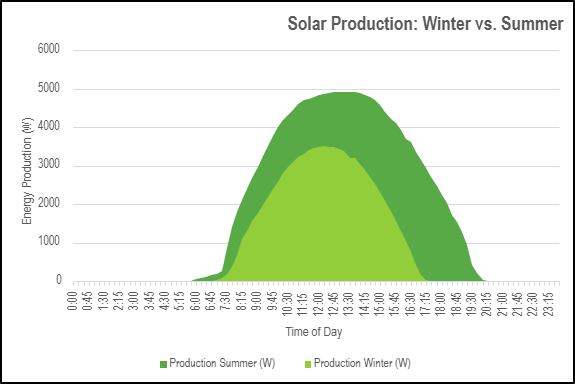
An immediate way to determine whether or not your solar production is working as intended is by understanding common production patterns. All solar production will typically follow the form of a bell curve, with the middle of the day being the most common peak production period. Depending on your system as well as the time of year, this bell curve can increase and decrease. For example, your solar production in summer will apply for a longer period and with higher efficiency during the day, resulting in a larger curve that spans for a longer period during the day. Compare this to winter, where your production will decrease in efficiency and may produce energy for approximately 2-3 hours less per day.
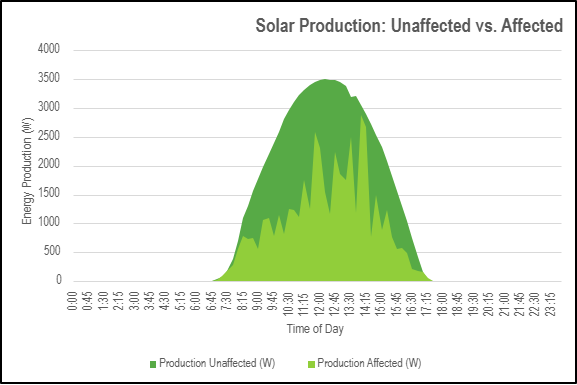
Weather can also play a major role in affecting your energy output. Within your energy production curve, it’s very common to experience significant dips in production. This most commonly occurs due to spontaneous weather deviations like cloud coverage and rain. It’s important to note that some weather conditions can cause obstructions to your panels (e.g. dirt and leaves from high winds), resulting in a reduced daily output. By cleaning your panels, this can return your panels to maximum efficiency.
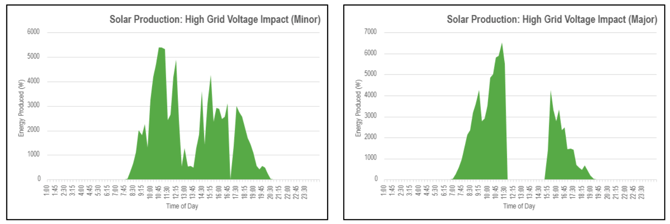
Another issue that may reduce daily output, even under ideal weather conditions, is high grid voltage. These situations are rare but may require some intervention from the energy distributor, which we can organise. The standard grid voltage in Australia is 230V, and home inverters are only permitted to operate when the voltage remains below 253V. When the voltage exceeds this threshold, the inverter reduces its output to help lower the voltage (see left graph). In extreme cases where this reduction is not sufficient, the inverter will shut down completely, cutting off all solar production from your home for periods of time (see right graph). All installations are inspected within the first few days for abnormalities such as high grid voltage, but the issue can sometimes appear months after your installation. If you experience this problem after installation, please contact SolarHub, and we will file a report with the relevant utility to resolve the high voltage in your area.
Common Energy Consumption Patterns
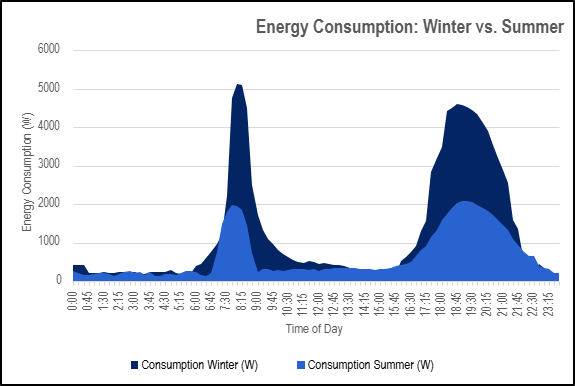
Energy consumption can commonly vary from day-to-day and from customer-to-customer, but there are two common patterns. The first pattern is that your highest energy consumption typically occurs during the morning and late afternoon. During these periods, you will most commonly experience the most usage of lighting, appliances, hot water, etc. However, you can make use of your solar production and enhance your self-consumption by timing your appliances to operate in the middle of the day.
The second pattern is that your energy consumption often increases significantly between summer and winter. The graph below represents the typical consumption for an average household in Canberra across winter and summer. On average, this household consumes over 70% more energy in winter than in summer weekly. With significant differentiation between temperatures, this occurrence is very common due to the increase in electrical heating appliances being used.
Production vs. Consumption: Solar-only System
During the day, it is very common for your solar system to produce more energy than your household consumes. For a solar panel system without a battery, the energy generated will follow two paths:
- To Home (Green): Your solar system’s priority is to match your consumption during generation hours, represented by From Solar (Dark Blue). If your solar system can produce more energy than required, your household won’t take any energy from the grid.
- To Grid (Blue): Once your consumption demand is matched, any additional solar energy generated will be sent to the grid. This exported energy earns you credit to help offset the required energy consumption when your panels aren’t generating.
For energy consumption not covered during solar generation, your home automatically draws energy From Grid (Orange). The graph below demonstrates a common relationship between production (above the line) and consumption (below the line).
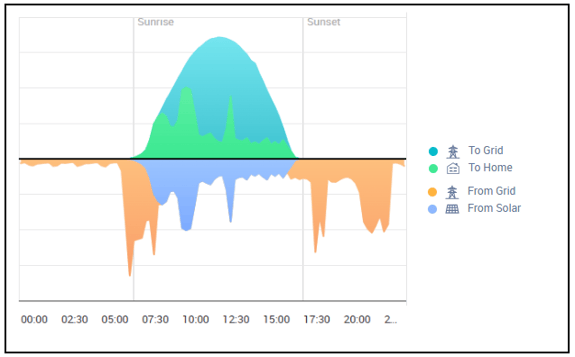
Excerpt from SolarEdge Monitoring
Production vs. Consumption: Solar + Battery System
How does adding a battery to your system affect your consumption of energy? With the addition of a battery storage system, a third path is created for your generated energy:
- To Battery (Light Green): Alongside matching your energy output, your system's second priority is to charge the battery to full capacity. This commonly is completed by the middle of the day, so any additional energy generated later in the day can be exported to the grid.
Later the same day, energy is discharged From Battery (Light Blue) to match the household demand. This continues until the battery has reached its discharge limit (e.g. the battery’s charge is 5%). This represents a typical battery charge/discharge cycle, although some systems can be customised to match your consumption (e.g. charging during the middle of the night to offset the morning peak). You can check with the SolarHub if this applies to your system.
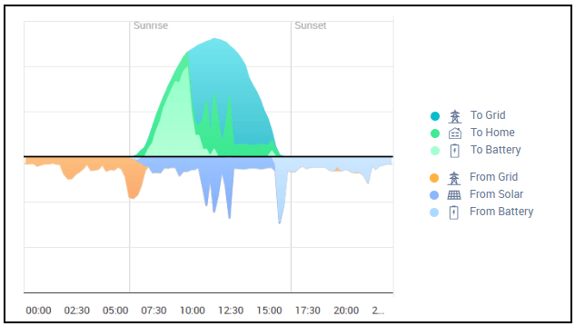
Excerpt from SolarEdge Monitoring
Additional Tips
With most monitoring software, you’ll receive a numerical breakdown of your energy production versus consumption. This gives you a quick and simple way to check your system’s performance. If you can’t access either production or consumption data, your system is most likely still operating, but there may be a communication error. In most cases, this can be resolved by checking the status of your inverter and communication gateway, then taking the appropriate action.

Excerpt from SolarEdge Monitoring
Understanding how your system operates can help determine any present issues that may arise. If you have any additional enquiries or encounter issues with your system, contact us by raising a Support Ticket and we can investigate the issues further.