
Article Contents
Overview
Understanding why your energy bill is higher in winter, even with a solar system, is key to managing your costs. Shorter daylight hours, weaker sun angles, and higher household demand for heating, lighting, and hot water all reduce how much solar can offset your usage. By knowing when and why your consumption spikes, you can adjust habits, schedule appliances during solar hours, and explore options like batteries to get the most out of your system.
Production: Daylight
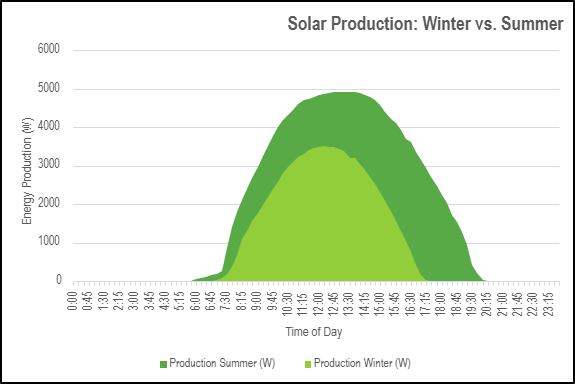
All solar production will typically follow the form of a bell curve, with the middle of the day being the most common peak production period. Depending on your system as well as the time of year, this bell curve can increase and decrease. For example, your solar production in summer will apply for a longer period and with higher efficiency during the day, resulting in a larger curve that spans for a longer period during the day. Compare this to winter, where your production will decrease in efficiency and may produce energy for approximately 2-3 hours less per day. The graph below represents a typical home during winter and summer. This home produces for over 3 hours extra during summer. Combine that with a decreased efficiency (touched on further), they produce only 51% of summers production in winter. Depending on the household, this number can be as low as 33%!
Production: System Efficiency
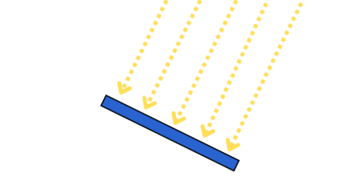
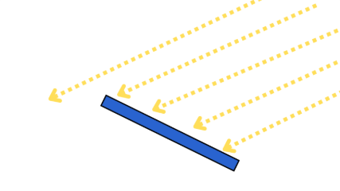
A factor that reduces solar production, even during peak hours, is the weaker sun. In summer, the sun sits higher in the sky, providing stronger and more direct sunlight. In winter, however, the sun is lower in the sky, resulting in less direct sunlight and therefore weaker solar energy. The further you are from the equator, the lower the sun appears in winter. For example, in Darwin, the sun remains relatively high even in winter, leading to warmer temperatures and longer days year-round. By contrast, in Canberra and Melbourne (both further from the equator), the sun sits much lower in the sky during winter months. This results in your panels receiving less direct sunlight, resulting in lower production during Winter.
 |
 |
| Summer | Winter |
The lower angle of the sun also means that panels installed at a fixed tilt may not be positioned to capture sunlight as effectively. If the tilt is optimized for summer production, the panels can receive sunlight at a shallower angle in winter, which reduces the amount of energy absorbed. This doesn’t change the panel’s efficiency rating itself, but it decreases the efficiency of your system because less sunlight is being converted into usable energy. The most effective solution is ensuring that you are utilising your home's north facing roof space, as even in winter, these panels will still receive the most exposure. Solar panels with an adjustable tilt are a potential solution but they're typically not recommended for a few reasons:
- Increased tilt heights can cast a shade that will impact your surrounding panels.
- Tilted panels catch more wind than a flat panel on a roof. Depending on the roof (for example, a flat Kliplock roof), clamps are used for solar panel rigs instead of drilling them in. The increased wind exposure can cause the clamps to loosen with time due to the higher pressure.
- They're not as aesthetically pleasing as flat solar panels.
 |
 |
| Summer | Winter |
Consumption: Usage
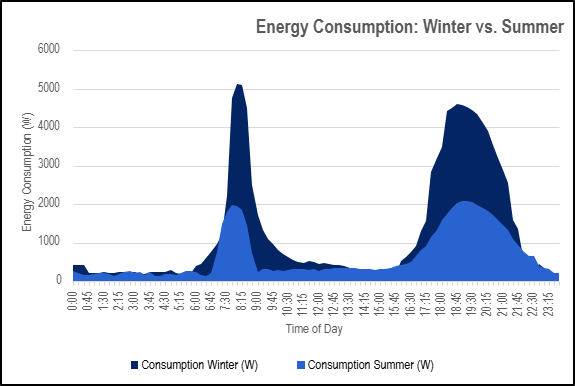
Your energy consumption often increases significantly between summer and winter. The graph below represents the typical consumption for an average household in Canberra across winter and summer. On average, this household consumes over 70% more energy in winter than in summer weekly. With significant differentiation between temperatures, this occurrence is very common due to the increase in electrical heating appliances being used.
Consumption: Time of Usage
For a standard home in winter, energy consumption is typically highest in the morning and late afternoon. These periods often involve the greatest use of lighting, appliances, hot water, and the aforementioned electrical heating. Since energy rates also rise during these peak times, much of your daily usage occurs when electricity is most expensive. Without a battery, your home relies solely on grid energy during these hours, driving up your bill. This can be significantly impactful towards your bill in winter especially as energy usage drastically increases. However, you can reduce costs by making use of your solar production and timing appliances to run in the middle of the day when your panels are generating power.
System Oversizing
Winter is always difficult. It's expected that reducing your bill down to $0 may not be feasible without significantly oversizing your solar array and battery (which is often impossible due to limited roof space). For majority of people, this isn't a cost-efficient solution either. Whilst having a larger system will increase your savings, it would also likely reduce your Return on Investment (ROI) and increase the payback period, so it's all about finding the right balance when sizing the system. We consider and oversize for winter, but within reason.
If you have any additional enquiries or encounter issues with your system, contact us by raising a Support Ticket and we can investigate the issues further.